
Safer access at height and in voids
Many nests are under eaves, in lofts, or behind wall surfaces. Reaching them safely matters as much as the treatment itself.
Serving Shrewsbury, England & surrounding areas
Mon–Fri 8am–6pm · Sat 9am–2pm
Fast, safe removal for active nests in lofts, wall cavities, sheds, eaves and hedges. Clear advice, careful treatment, and straightforward next steps for homes and businesses.
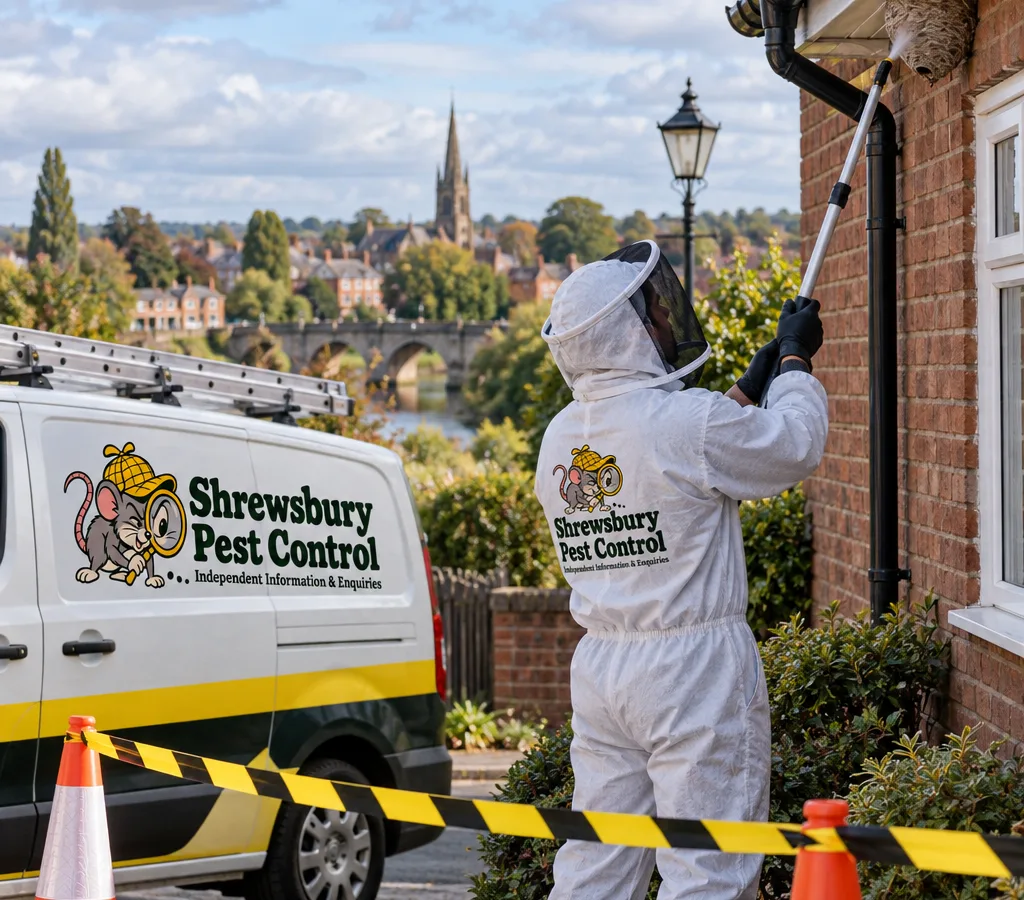
If you have an active nest on your property, wasp nest removal Shrewsbury is usually about one thing: making the area safe again without driving wasps further into the building. Shrewsbury Pest control deals with nests in common spots like fascia boards and soffits, lofts and roof voids, cavity walls, garages and outbuildings, and thick shrubs or hedges along paths.
In Shrewsbury you often see nests discovered around older rooflines, behind cladding, or tucked into outbuildings where people only notice activity when the weather turns warm and windows and doors are open more. We focus on practical containment: identify the entry point, treat the nest with the right product and dose, and give clear instructions on when it is safe to use the area again.
We work as a pest control company Shrewsbury homeowners rely on and keep the process simple: tell us where you are seeing wasp traffic, what the nest access looks like, and whether anyone in the property has a known allergy. From there we can advise on urgency and the safest way to approach removal.
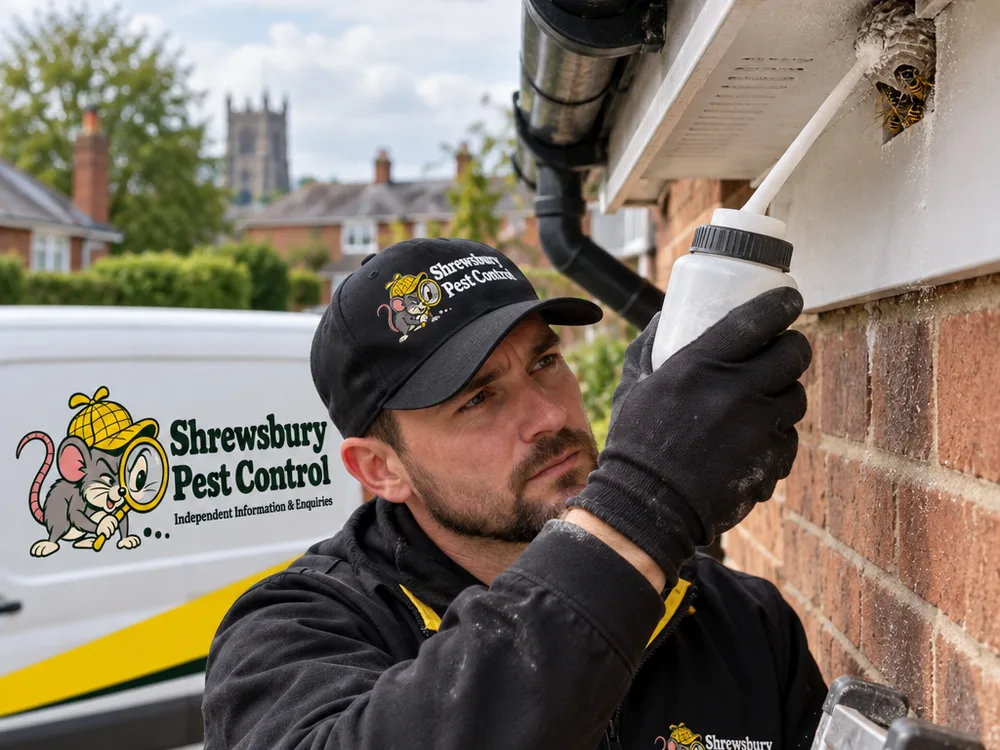
A proper wasp nest job starts with confirmation of species and location. In the UK, the most common problem is social wasps, which defend the nest and can sting repeatedly. If we can safely see the nest or the main flight line, we will choose a treatment method that reaches the nest core rather than just knocking down the visible wasps.
Typical approach:
If the nest is in a cavity wall or roof void, it is normal to still see some activity for a short time as returning workers contact the treatment. We will explain what “normal” looks like and what would indicate a follow-up is needed.
For commercial sites around Shrewsbury town centre, or busy footfall areas like entrances and bin stores, we prioritise safe timing and cordoning so staff and the public are not put at risk.
Many nests are under eaves, in lofts, or behind wall surfaces. Reaching them safely matters as much as the treatment itself.
Effective control targets the nest core via the entrance or direct contact, which is especially important for hidden nests.
You get practical instructions on exclusion zones, timing, and what to do if you find a second entry point.
We aim to treat quickly and leave you with a plan for safe re-entry and any follow-up steps.
If the insects are bees rather than wasps, the approach is different. We will talk you through the safest next step based on what you are seeing.
Wasp nest removal in Shrewsbury typically costs about £70 to £150 for a straightforward, accessible nest, with more complex jobs involving height, difficult access, or nests inside cavity walls or loft voids often ranging £150 to £250+. If there are multiple active nests on the same visit, pricing is usually based on how many locations need treatment.
Your final price depends on access, including ladder work and roofline clearance, whether the nest is visible or in a void, how far treatment must be applied into a cavity, and any site constraints such as tight alleys or busy commercial entrances. The exact cost is confirmed after we understand the nest location and access at the property.
Describe where wasps are entering and exiting, approximate height, and whether the nest is visible. Mention any allergy risk so we can advise on urgency.
We check access, choose PPE and equipment, and set a sensible exclusion zone. For loft and cavity work, we look for the primary entrance and flight line.
We apply an appropriate insecticide to reach the nest core. For voids, dusting into the entrance is often the most effective way to carry treatment through the nest.
You get clear instructions on when it is safe to use the area, what level of remaining activity is normal, and what to do if activity does not drop as expected.
Shrewsbury has a mix of older terraces, extensions, and modern estates, so we see a wide range of nest locations. The practical difference is access and how hidden the nest is.
In Belle Vue and other areas with more traditional housing and pitched roofs, nests often appear along eaves and soffits, or just inside roof voids where a small gap gives wasps a steady entrance. That usually means careful ladder positioning and treating through the entry point rather than trying to remove anything by force.
Around Bayston Hill and similar residential streets with garages, sheds, and fencing, nests are commonly found in outbuildings and along boundary lines. The key is keeping people and pets away while the treatment takes effect, because these are the spaces families use every day.
In Meole Brace, where there are plenty of hedges and garden structures, ground-level nests in shrubs and compost areas can be an issue. These are easy to stumble on, so we focus on making the immediate area safe first and then treating at the right time of day.
For properties closer to Shrewsbury town centre, access can be tight, with shared passages, small courtyards, and higher foot traffic. We plan for safe entry and exit, and for commercial premises we work around opening times where possible.
If you are also dealing with insects inside the property, it can help to separate the issues: a wasp nest is controlled by treating the nest itself, while general crawling insects are handled differently through insect control.
“We had wasps going in under the fascia and it was getting worse each day. The technician explained what he was doing, treated the entrance, and told us exactly when it would be safe to use the patio again.”
“Nest was in the loft and we were worried it was in the insulation. They found the entry point, treated it properly, and the activity dropped off over the next day.”
“We needed a quick response for our staff entrance. They handled it safely, kept the area controlled, and gave us clear instructions for the rest of the day.”
Availability depends on demand and the risk level, but active nests near entrances, patios, loft hatches, or workplaces are treated as urgent. When you get in touch, tell us the nest location, how close it is to where people pass, and whether anyone has a known sting allergy so we can advise on the safest timing.
In many cases we treat the nest so the colony dies off, and physical removal is optional once activity has stopped and it is safe to access. Removal is most useful when the nest is visible and reachable, but for cavity-wall and roof-void nests, treatment through the entrance is often the safest and most effective option.
Yes, in most situations you can stay at home, but you must keep away from the treated area for the advised period. For loft or cavity treatments, you may be asked to avoid opening nearby windows or disturbing the entry point until activity drops.
That is common in Shrewsbury properties where wasps use a small gap at the eaves or brickwork to reach a cavity. The job focuses on finding the main entrance and treating through it with a product that carries into the nest; sealing the gap too early can push wasps to find another way out indoors.
For small, exposed nests at low level, shop sprays can sometimes help, but they also increase sting risk and often do not reach a hidden nest core. If the nest is in a loft, wall cavity, under tiles, or at height, professional treatment is the safer option because access and correct application matter as much as the chemical.
If the insects are bees, the approach is different because bees are valuable pollinators and are handled with care and, in many cases, referral to a beekeeper. If you are not sure what you have, describe the insect and where it is entering, and we will advise on the appropriate next step before any treatment.
Wasps do not typically reuse an old nest, but they can choose a similar sheltered void if the access gap remains. Once the nest is inactive, we can advise on sensible proofing steps such as repairing a damaged soffit edge or sealing small entry gaps, and for broader prevention you may also want rodent proofing if you have multiple building entry points to address.
Tell us where the wasps are entering and how close the nest is to doors, patios, loft hatches, or staff areas. We will recommend the safest approach and arrange prompt wasp nest removal in Shrewsbury.